
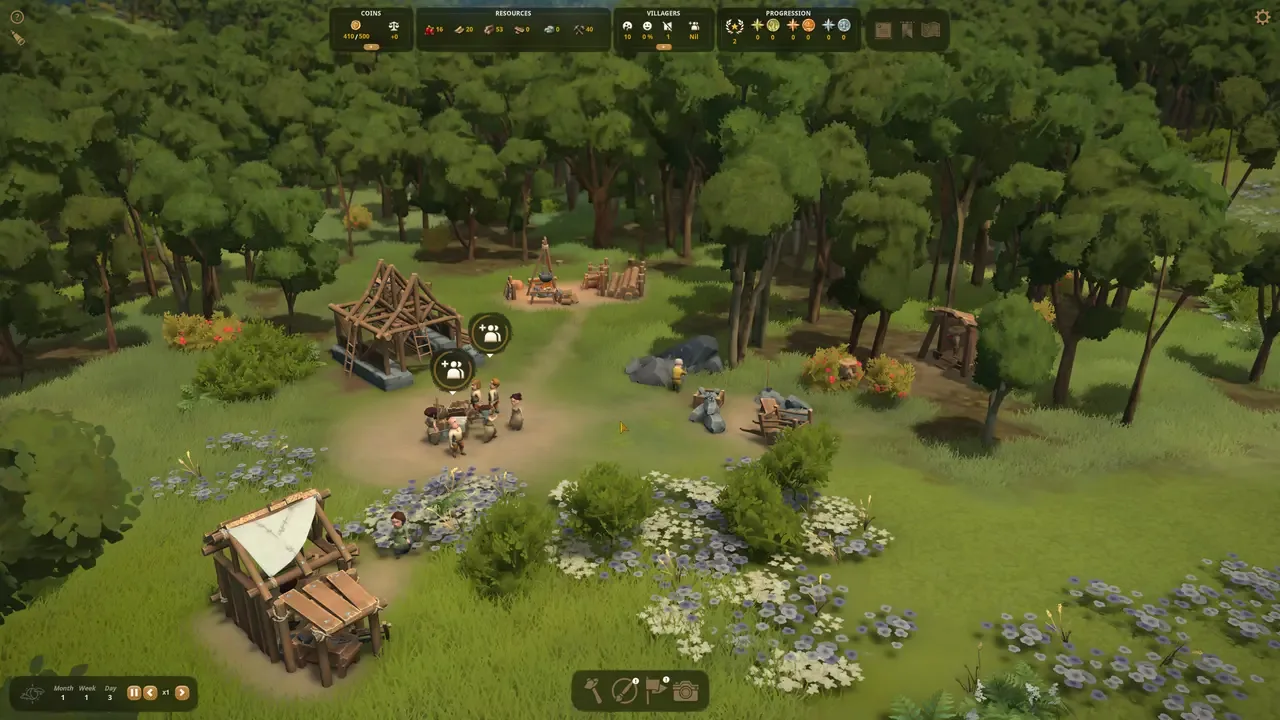
After six years in Early Access, Foundation finally launched its full 1.0 version in January 2025, and the city-building community is buzzing. This isn’t your typical grid-locked medieval sim where you plop down identical houses like Tetris blocks. Foundation lets your cities grow organically, sprawling across landscapes like real medieval towns did—messy, beautiful, and occasionally catastrophic when you forget where you put the well.
I’ve spent 40+ hours with the full release. Here’s what actually matters.
What Makes Foundation Different (And Why That’s Complicated)
The grid-less building system is Foundation’s calling card. Instead of snapping buildings to pre-determined squares, you’re painting residential zones and letting houses pop up naturally along roads. It creates stunning, realistic-looking towns that feel lived-in rather than stamped out by a city planner with OCD.
But here’s the catch: this freedom comes with consequences. You can’t perfectly optimize layouts. Sometimes villagers build houses in dumb spots. Your carefully planned cathedral district becomes a chaotic jumble because three families decided they needed to live RIGHT THERE.
For some players, this is immersive brilliance. For min-maxers, it’s torture.
The Three Progression Paths (And Why You’ll Restart Five Times)
Foundation structures advancement around three systems:
- Labor Path: Traditional resource chains—farms, mines, production buildings. The economic backbone of your settlement.
- Clergy Path: Building churches and monasteries to generate faith, which unlocks religious policies and keeps villagers happy.
- Kingdom Path: Fulfilling royal decrees and constructing monuments to gain prestige and unlock advanced content.
The interplay is clever. You can’t just spam houses and win. Balancing all three systems while managing finite resources creates genuine strategic tension. But the game doesn’t explain this well upfront, which means your first two settlements will probably collapse into economic death spirals.
Monument Building: The Endgame Hook
The monument system deserves special mention. Instead of pre-built wonders, you design cathedrals piece by piece—choosing layouts, adding chapels, planning courtyards. It’s basically creative mode nested inside the strategy game.
Watching your custom cathedral take shape over hours of gameplay hits different than clicking a “build wonder” button. The downside? It requires massive resource investment, and if you miscalculate your economy, construction grinds to a halt while villagers starve. Priorities!
The Interface Overhaul (Finally)
The 1.0 release brought a completely redesigned UI, and thank god. Early Access menus were a confusing mess. The new interface is cleaner and more intuitive, though longtime players report needing time to adjust after years of the old system.
New features include a photo mode for capturing your city, improved tooltips, and better onboarding tutorials. If you tried Foundation years ago and bounced off the learning curve, version 1.0 is legitimately easier to get into.
The Modding Apocalypse
Here’s the big controversy: the full release nuked most existing mods. Years of community-created content stopped working overnight. The modding scene, which was thriving during Early Access, is now rebuilding from scratch.
Some modders are updating their work. Others have moved on. The developers released updated tools, but documentation is sparse. If you were counting on mods for quality-of-life features, you’re currently out of luck.
This is a legitimate problem for replayability. Vanilla Foundation is excellent, but mods added hundreds of hours of extra content. That ecosystem needs time to recover.
Performance and Technical State
On a mid-range PC (RTX 3060, 16GB RAM), Foundation runs smoothly until cities hit around 800-1000 population. Then framerates start dipping, especially with all graphical settings maxed. Large cities with multiple monuments can chug.
The game looks gorgeous though. Seasonal changes, day/night cycles, and weather effects make your cities feel alive. There’s something meditative about zooming in and watching villagers go about their routines.
Bug-wise, the 1.0 release is stable. A few pathfinding hiccups and rare crashes, but nothing game-breaking in my playthrough.
The Content Question
Foundation offers multiple difficulty levels, a creative sandbox mode, and enough gameplay systems to justify 50+ hours. But compared to genre giants like Cities: Skylines or Anno 1800, the content volume is lighter.
There’s no campaign. No scenarios. Just sandbox mode with different settings. Once you’ve built a few successful cities and experimented with monument designs, you’ve seen most of what the game offers.
The developers have been quiet about post-launch DLC plans. Some Reddit users worry about update frequency and long-term support. Others point out the game was in Early Access for six years—maybe they deserve a break.
Who Should Buy Foundation in 2025?
Buy if: You want a relaxing, visually stunning city builder that prioritizes aesthetics over optimization. You enjoy the journey more than mechanical complexity. You’re okay with some jank in exchange for unique systems.
Skip if: You need deep economic simulation. You want campaign content. You’re waiting for the modding scene to fully recover. You prefer controlled, grid-based building.
The Elephant in the Room: Is It Worth $30?
Foundation costs $29.99, which feels fair for what you get. It’s not a 500-hour forever game, but it offers a distinct experience you can’t get elsewhere. The organic city growth alone justifies the price for the right audience.
That said, waiting for a sale wouldn’t hurt. At $20, it’s an instant recommendation. At full price, it depends how much the grid-less concept appeals to you.
The Developer Communication Issue
Some players report frustration with developer Polymorph Games’ communication post-launch. Update frequency has slowed compared to the active Early Access period. The roadmap for future content is vague.
This isn’t uncommon after a long development cycle. But for players who invested years in Early Access, the relative silence feels jarring. A clear post-launch plan would do wonders for community confidence.
Final Thoughts: A Unique Vision, Executed
Foundation succeeds at what it sets out to do: create a medieval city builder focused on organic growth and visual beauty over mechanical depth. It’s not perfect—the mod situation sucks, the late-game can feel thin, and the learning curve is steeper than it should be.
But when you zoom out and see your sprawling, chaotic, uniquely yours medieval city stretching across hillsides, with your custom cathedral dominating the skyline? That feeling is worth the price of admission.
Just maybe wait for a few more patches and mod updates first.
⚗️ HOARDING POTIONS VERDICT ⚗️
Potion Rating: 🧪🧪🧪½ out of 5 (3.5 Potions)
Worth Hoarding? Yes, but with caveats. Foundation offers something genuinely different in the medieval city-building space. The organic growth system creates beautiful, unique cities that justify the purchase for players seeking aesthetic satisfaction over mechanical depth. However, the disrupted modding scene, thin late-game content, and uncertain post-launch support keep this from being an essential hoard. It’s a strong buy at sale price, a “maybe” at full MSRP depending on your priorities.
Best For:
- Players who value city aesthetics over optimization
- Fans of relaxed, meditative building experiences
- Medieval setting enthusiasts tired of grid-based building
- Creative types who’ll spend hours designing custom monuments
- Anyone seeking a unique city-builder that breaks genre conventions
Skip If:
- You need deep economic simulation and mechanical complexity
- Campaign content and structured scenarios are essential
- You’re a min-maxer who can’t tolerate inefficient layouts
- Waiting for the modding ecosystem to recover is a dealbreaker
- You want clarity on post-launch content and developer communication
- Performance issues with large cities on mid-range PCs concern you